

Carine Chen-McLaughlin was 65 when she enrolled in the study.
She’d been smoking for decades, and she’d tried to stop the way everyone tries to stop. Nicotine gum. The patch. Cold turkey.
Nothing held for more than a couple of days.
But when she described what made quitting so hard, she didn’t talk about cravings or withdrawal. She described it as saying good-bye to a very old friend, and wondering whether she’d be okay without it.
That’s the part the patch doesn’t address.
You’re not just removing a chemical. You’re removing something that’s been present at every difficult moment of your adult life.
The numbers here are genuinely bleak.
Smoking is the leading preventable cause of death worldwide, and current treatments, including varenicline, bupropion, nicotine replacement, and behavioral therapy, show limited effectiveness. Used optimally, only 25 to 35% of people who try to quit stay abstinent for six months or longer.
That’s the best case. Varenicline, widely considered the most effective cessation drug available, gets roughly 35% six-month success. Most other approaches land under 30%.
Which means the overwhelming majority of people who genuinely want to quit don’t.
Not for lack of trying. The people in these studies had already tried, repeatedly, for years.

In 2014, researchers at Johns Hopkins ran a small pilot.
Fifteen participants, averaging 19 cigarettes a day for 31 years, with a mean of six previous lifetime quit attempts. Fifteen weeks of cognitive behavioral therapy, combined with two or three psilocybin sessions.
These were not casual smokers. These were people who had spent three decades failing to stop.
At six months, the abstinence rate was 80%.
Verified by breathalyzer and urine analysis, not self-reported.
Eighty percent, against a field where thirty-five is considered excellent.

This is where it stops looking like a fluke.
Every one of the fifteen participants came back for a twelve-month follow-up, and 10 of them, 67%, were still confirmed abstinent.
Then researchers checked again, an average of thirty months out. Nine of the original fifteen, 60%, were still not smoking.
Two and a half years.
People who had smoked for thirty-one years, who had failed six separate quit attempts, who had every reason to relapse, still not smoking years on.
80% at six months. 67% at twelve. 60% at thirty.
Not a spike that faded. A change that held.
And at that twelve-month mark, 13 of the 15 rated their psilocybin sessions among the five most personally meaningful and spiritually significant experiences of their lives.
The pilot was tiny. Fifteen people, no control group. Easy to dismiss.
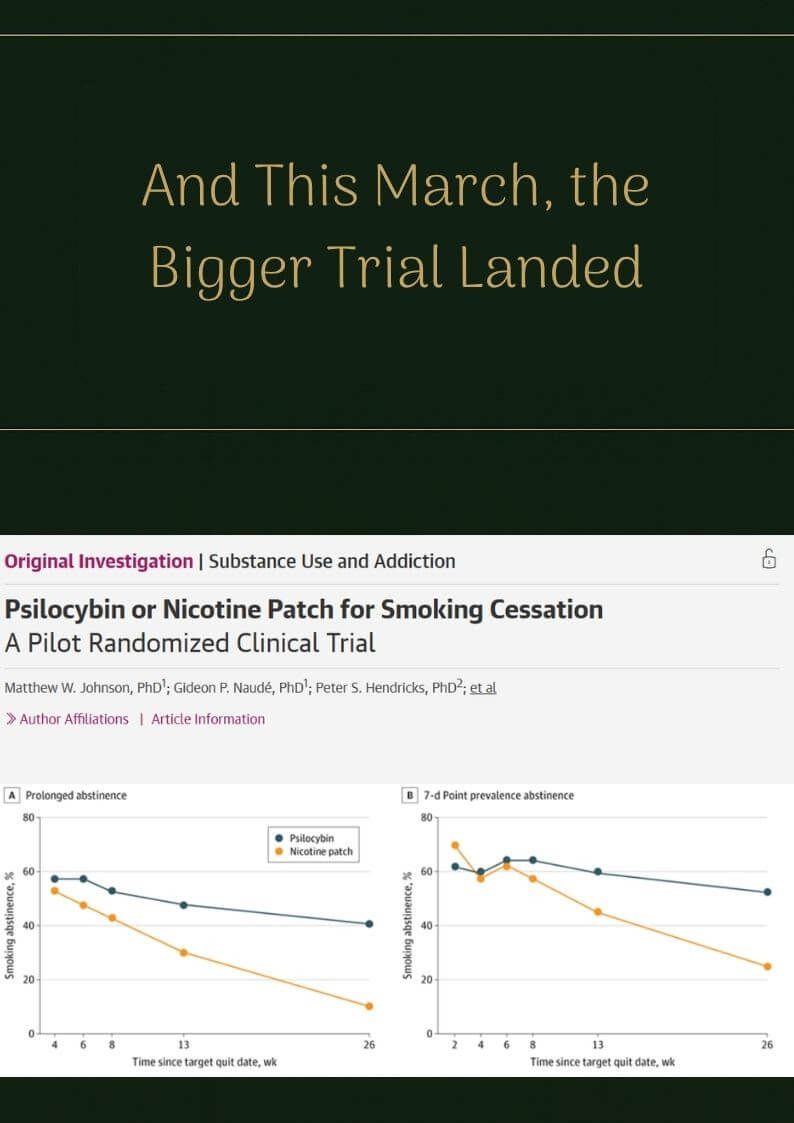
So researchers ran it properly: 82 smokers at Johns Hopkins, randomized, published in JAMA Network Open. Participants averaged 15.7 cigarettes a day with a median of six previous quit attempts.
Everyone received thirteen weeks of cognitive behavioral therapy. One group got a single high dose of psilocybin on their quit date. The other got eight to ten weeks of the FDA-approved nicotine patch.
At six months, 40.5% of the psilocybin group had achieved prolonged abstinence. In the patch group, 10%.
More than six times greater odds, from one dose, against months of the standard treatment.
Matthew Johnson, who led the work, put it plainly: he was surprised by the sheer magnitude of the effect.
When a researcher who’s spent a decade on something says he was surprised by his own results, that’s worth noticing.

Why it works differently?
Johnson has been careful about the mechanism, and his explanation is the most interesting part of all of this.
Quitting smoking isn’t a simple biological reaction to psilocybin the way it is with medications that act directly on nicotine receptors.
It isn’t blocking anything. It isn’t substituting anything.
What it seems to do is change the relationship. Johnson describes it as helping people step outside the stories they tell themselves, broadening perspective, and giving them room to respond to cravings mindfully rather than reflexively.
The craving still arrives. What changes is whether you’re standing inside it.
Which brings us right back to Carine’s framing. If the hard part is losing an old friend, then no nicotine patch is ever going to touch it. That’s not a chemistry problem. That’s an identity problem.

Nearly everyone reading this knows a smoker.
A parent who’s been meaning to quit for twenty years. A friend who quits every January. Maybe yourself, if you’re honest about it.
And the story is almost always the same. Not that they don’t want to stop, but that they’ve stopped believing they can. After enough failed attempts, quitting stops feeling like a decision and starts feeling like a fixed fact about who you are.
What this research suggests is that the fact isn’t fixed.
The studies are still ongoing. This is now the first federally funded research on a classic psychedelic as a therapeutic in roughly fifty years, which tells you how seriously it’s being taken, and how long we went without asking.
But the direction is clear. People who had failed six times, who had smoked for three decades, who described it as losing a friend, walked out of a room in Baltimore and didn’t smoke again.
Some of them are still not smoking, years later.
That’s not a small thing. For a person who’d stopped believing it was possible, it’s the whole thing.
Water Your Mind 💚
Mushie Media of the Week:
"A Dose Of Psilocybin Helps Smokers Quit In New Study"
by: NPR