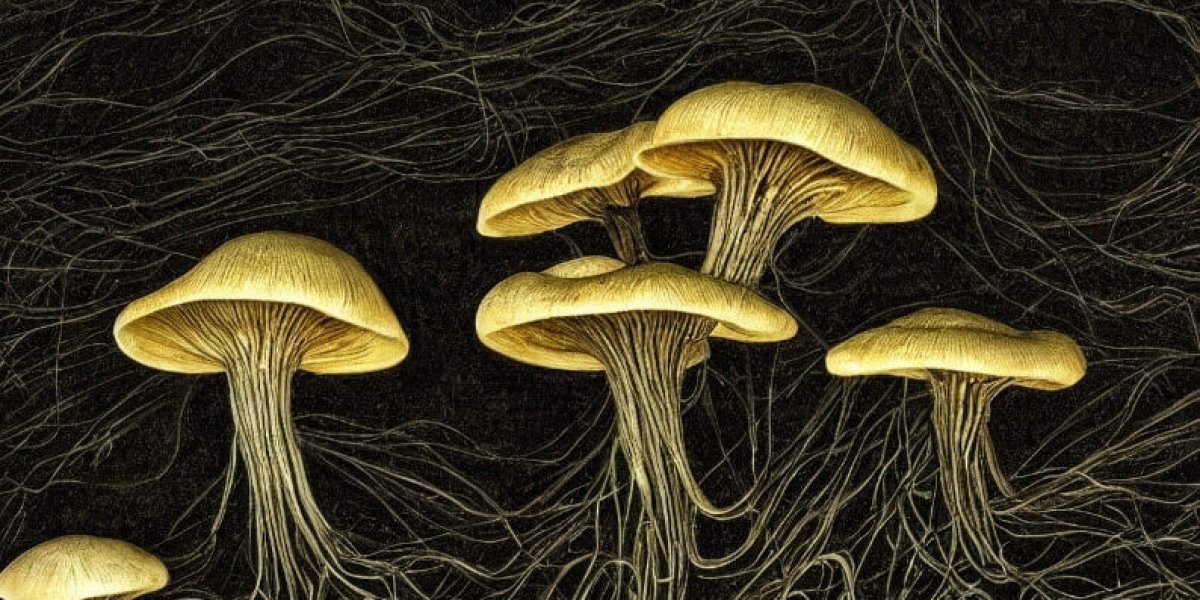
The Boldest Claim in Psychedelics.
In 1992, an ethnobotanist named Terence McKenna published a book with an idea so audacious that scientists have been arguing about it ever since.
His claim: psilocybin mushrooms made us human.
Not helped. Not influenced. Made. He proposed that the leap from Homo erectus to Homo sapiens — and everything that came with it — happened because our ancestors started eating psychedelic mushrooms.
It’s called the Stoned Ape theory. And more than thirty years later, it remains the most argued-over idea in the entire field.

McKenna's version is genuinely elegant, which is part of the problem.
As Africa dried out, hominids retreated into shrinking forests and followed cattle herds — whose dung attracted insects that were part of the human diet.
And psilocybin mushrooms grow on dung.
So our ancestors weren’t seeking them out. They were walking through fields of them, day after day, generation after generation, while foraging for something else entirely.
McKenna argued the effects scaled by dose: low amounts sharpening visual acuity for hunting, higher amounts stimulating the language-forming region of the brain.
He suggested psilocybin was an evolutionary catalyst that triggered language, imagination, the arts, religion, philosophy, and science.
The whole of human culture, from a mushroom on a pile of dung.
McKenna's argument was largely ignored by the scientific community.
McKenna’s argument was largely ignored by the scientific community, which cited numerous discrepancies and a general lack of evidence.
The objections are specific and they’re serious.
The timeline doesn’t work. Fossil evidence shows relative brain size in the genus Homo barely changed between 1.8 million and 600,000 years ago.
The real increase came after 600,000 years ago and continued until roughly 35,000 years ago — when brain size actually began to slightly decrease.
That’s a gradual, complex trajectory. Not the sudden leap the theory requires.
And there’s no physical evidence. Researchers have analyzed hardened dental plaque from Upper Paleolithic humans and found traces of edible mushrooms and medicinal plants — but no psilocybin mushrooms or spores have ever turned up.

Here's the one that's hardest to argue around, and it's beautifully simple.
Temporary changes to perception, however profound, don’t alter DNA.
For psilocybin to have driven evolutionary changes in brain size, there would need to be some mechanism by which the experience of taking it became heritable — passed to offspring genetically.
McKenna never fully addressed that.
Archaeologist Elisa Guerra-Doce, who specializes in prehistoric drug use, put the broader critique plainly: the hypothesis is too simplistic, and several factors played their part in human evolution.
Dennis McKenna — Terence’s brother, and the theory’s most committed advocate — has since acknowledged the counterargument.

By any normal standard, this idea should have quietly disappeared decades ago.
Instead it got a second life. In 2017, mycologist Paul Stamets publicly endorsed it, calling it an unprovable hypothesis — but a very plausible one for the sudden evolution of Homo sapiens away from our primate relatives.
And here’s the genuinely interesting part.
The science has moved toward McKenna, even as it rejects his conclusion.
Psychedelics are now understood as psychoplastogens — compounds that stimulate neuroplastic change in the brain. Recent evidence shows psilocybin increases brain connectivity and stimulates neurogenesis and neuroplasticity.
McKenna was guessing in 1992. He guessed that this compound does something structurally significant to human cognition.
On that, he turned out to be right. He was just wrong about the scale.
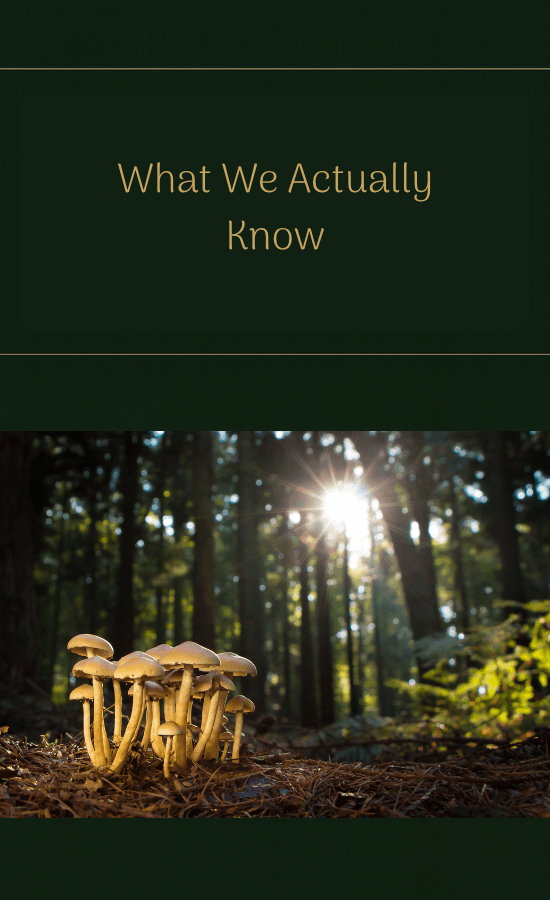
Strip away the speculation and what remains is still remarkable.
At least 23 primate species have been documented consuming fungi.
Historical records show psychedelic mushroom use across Mesoamerica, Siberia, and parts of Africa.
None of that proves anything about human evolution. But it does establish something worth sitting with: psychedelic fungi have been part of the human–environment relationship for a very long time.
We didn’t discover these mushrooms recently. We’ve been in a relationship with them for as long as we’ve been walking around.
The Stoned Ape theory is almost certainly wrong in its strong form.
The Stoned Ape theory is almost certainly wrong in its strong form. The fossil record doesn’t support it, the archaeology hasn’t found it, and the mechanism was never explained.
But being wrong isn’t the same as being useless.
McKenna asked a question nobody else was asking — whether a compound that profoundly alters cognition might have shaped the species that kept encountering it. He answered it too boldly and with too little evidence. But the question survived him, and the field caught up to a smaller version of it.
Psilocybin does increase neuroplasticity. It does create new connections. It does loosen fixed patterns of thought.
Not across two million years of evolution. Across a single afternoon, in a single brain.
That’s a more modest claim than McKenna’s. It’s also verifiably true — which is a trade most scientists would take.
The mushrooms didn’t build the human mind.
But they can still change one.
Water Your Mind 💚
Mushie Media of the Week:
"The Stoned Ape Theory Revisited"
by: Psychology Today